I was recently visiting my aunt Kathy McGuire at her home in Virginia. She had pulled out some boxes of photos and slides as she was reminiscing about SUNY Buffalo’s Center for Media Study where she studied Art History in the mid-1970s. A copy of Buffalo Heads sat on the coffee table before us. The massive 900-page book is a historical and visual archive celebrating the avantgarde filmmakers and video artists whose work was featured in a comprehensive, multimedia installation at the Center for Art and Media (ZKM) in Karlsruhe, Germany, where I live.
Kathy was holding one of the transcriptions of Chopin’s Etudes Opus 10 made by flicker film artist Paul Sharits, who had been a faculty member at SUNY Buffalo where he helped shape its Media Study program. A gift to her from Paul, it was one of a series of colored silkscreen prints titled ‘Transcription’ he’d made based on Chopin’s work.
Remembering Paul Sharits
“Paul was extremely intense,” Kathy recalled, sifting through piles of black and white photos she’d taken of her friends. “He had an unusual way of visually interpreting a musical score, more focused on the structure than the music itself,” she said, as we both peered closely at the bands of color surrounding the notes and chords on the silkscreen print.
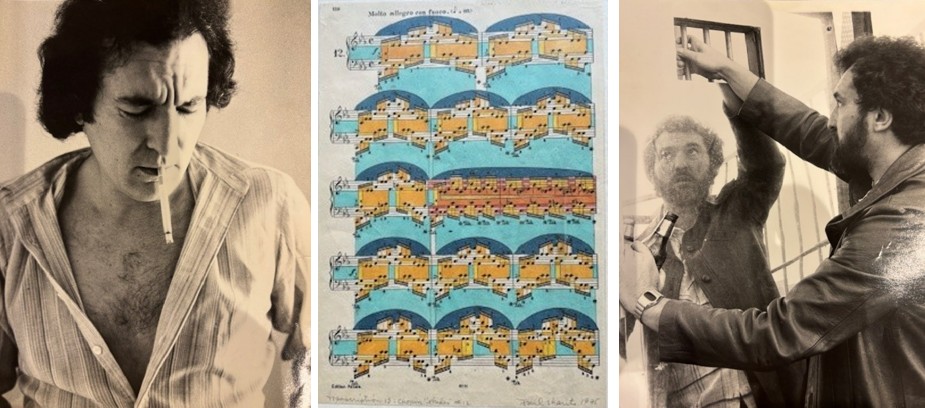
Sharits used the same type of visual approach for treating the film strip as a physical object. He first drew his films on graph paper with colored felt tip pens, much like a musical score, to plan the sequence of single-color frames. His flicker films, for example, focus on the physical experience of viewing film itself, rather than telling a narrative story. The rapid flickering of colors causes the viewer’s eyes to produce new, temporary hues through visual interaction. He became one of the most prominent video artists of all time.
“Paul didn’t use colors in a symbolic way. He used them to create a physical, perceptual experience,” she said. “We remained friends for years. I was deeply sorrowed when I heard of his death.”
Life in New York
In 1976, Kathy moved to New York city where she was hired as Deputy Director of the Visual Art Department of the Americas Society, an organization dedicated to Central and South American art and culture.
In that role she worked closely with John Stringer, the influential curator who had gained prominence in his previous position with the Museum of Modern Art (MoMA). Together with Stringer, she curated numerous shows and worked closely with the Americas Society Advisory Board in selecting artists.
“John taught me to think of curating as a cultural responsibility, not just a profession,” Kathy explained. “When artists came in for interviews, John could always tell if that person understood where their work sat historically and internationally as part of a larger continuum.”
Kathy was also on the Advisory Board of the Museo del Barrio, a cultural museum dedicated to Caribbean and Latin American art, with a particular focus on Puerto Rican contemporary culture. “One of the most memorable artists whose work I curated was the avantgarde Cuban photographer Ricardo Zulueta,” said Kathy, who grew up in Brazil and always felt a close affinity to Latin America. “His critique of authoritarian structures and exploration of how political systems shape everyday life is totally relevant in the current political landscape through its focus on displacement, migration, and identity.”
Later she managed a private art and antiquities dealership in New York for its absentee owner. “I had power of attorney to do everything for him,” she recalled. “I was in charge of inventory, shipping, storage, you name it. I had to manage the clients, and advise buyers. I had to confirm the authenticity of artworks and artifacts for auction houses like Sotheby’s, all this before we had the digital tools that make this kind of work much easier today.”
From curator to chef
In 1996, Kathy and her husband Bashir Khelafa, an Algerian musician, moved to Charlottesville, Virginia to start a new life in the restaurant business. Bashir’s Taverna dominated Charlotteville’s culinary scene for decades. It was THE iconic spot for dinner parties, musical events and belly dancing on Friday nights. According to one of their regular patrons, “the downtown mall was their living room.”
Transitioning from curator to chef might seem like a big leap, but Kathy pointed out some surprising similarities in the creative process. Like curators arranging artworks to create a visual flow in an exhibition, cooks and chefs arrange dishes and ingredients to create a visually appealing and balanced presentation. Both jobs require aesthetic sensibility, composition, and storytelling through visual cues.
“I often thought about Jackson Pollack while I was putting together a plate,” she said with a laugh. “What was so great about him was his intuitive way of creating things. He’d put the canvas on the ground, walk around it, stand over it just staring, and then start dribbling paint all over it.”
Kathy believes that for artists like Pollack, art isn’t an intellectual thing; it’s about expressing an inner vision. “I have a feeling like that when I cook. If I want to make a certain sauce, I stir things together, taste a little, add more of this or that. There’s really no technique; it’s intuitive.”
Creativity does not stop with age. At 82, Kathy is collaborating on a multimedia book titled Buffalo Heads Up Close – From Then to Now, featuring some of the artists and visionaries who established SUNY Buffalo as an international center of avantgarde media and led to the establishment of the ZKM in Germany.
“They were experimenting and playing with film, sound and video in multiple ways, inspiring the creative digital art styles we see today,” she said.