Rob Humphrey once swore he would never become a musician. Now, he can’t imagine living any other life. But his story doesn’t begin on a stage. It begins in Northern Ireland, outside Omagh, with three older sisters, a mother who was a shopkeeper, and a father who sold car parts and played in a wedding band. As a child, Rob saw music as hard work: lugging heavy equipment, late nights and a father who was often away over the weekends.
“It was clear that playing music was not for me, but listening to it was something else,” he says as he recalls discovering his father’s vinyl collection. There was the crackle of the record, the oversized headphones, and the realization that music could transport him somewhere else. He became fascinated by rock’n’roll, particularly artists such as Elvis and Chuck Berry.
But he never sang a note until he was 32.
From the military to the music studio
Before becoming a musician, Rob spent around 12 years in the military, an experience that took him to different parts of the world and exposed him to people and environments far removed from his upbringing. He describes that chapter of his life not through hardship, but through adventure, friendship, camaraderie and some valuable life lessons.
Growing up in Northern Ireland during a period of deep sectarian division, Rob became aware from an early age of the tensions that existed between the two communities. Raised during the Northern Irish conflict, he absorbed the deeply ingrained divisions between the two communities and initially accepted them as normal. At 16, he moved to England, where exposure to a different environment gave him a new perspective.
“I started to realize how abnormal that environment had been,” he says.
After leaving the military, Rob moved into property development. It was the right time and the right place. Belfast had suffered extensive damage during the Troubles, leaving parts of the city neglected and economically depressed. Ever the entrepreneur, Rob bought houses and buildings and developed them into apartments and holiday lets. Business took off. Then his son broke his leg, and Rob took a year off from work to look after him. Suddenly, he had a lot of time on his hands, and an old idea reared its head.
“I was faced with the question: what exists because of you? For me, the answer was an album. I’d always wanted to write one, so I had my property-development team turn my dining room into a recording studio. I told everyone I was going to make an album. Most people laughed, but one person didn’t,” he says.
The making of MASK
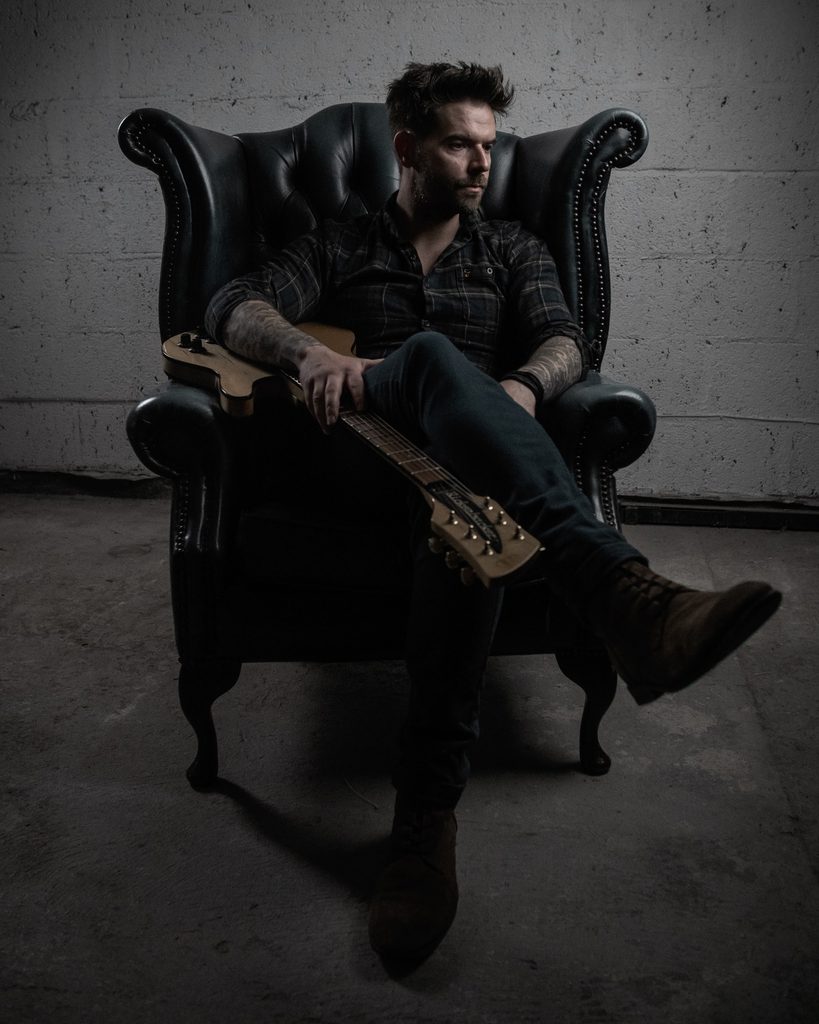
His old friend Craig Coppock flew over from Liverpool, and they formed a band. They named it MASK. There was just one problem. Rob was so terrified of singing that he had to sign up for lessons.
“The first year of singing lessons was one of the most terrifying experiences of my life,” he says. He was so frightened that he would find excuses to talk to his teacher rather than actually sing. He would look up things happening in the news simply to have something to discuss. For six months, he managed to avoid the central purpose of the lessons. Then, Pauline Carville, the owner of the singing school, confronted him.
“She gave me some completely ludicrous singing exercises, to the point where we both just burst out laughing. A lesson was learned — I needed to stop taking it all so seriously,” he recounts.
That moment finally broke the ice. Rob finally started singing, making the transition from songwriter to lead vocalist.
The band’s debut album, The Famous (2018), was a collection of atmospheric, blues-driven indie rock that caught the attention of music critics and audiences alike. Several more albums followed. Their music has amassed more than 3 million streams and downloads worldwide, attracting a growing international audience and averaging more than 5,000 monthly Spotify listeners.
For Rob, success isn’t about being the greatest musician in the room. It’s about connection. Authenticity isn’t about constructing an image. It’s about telling your own stories, which may explain why songwriting has become such a natural fit for him.
“It’s that Irish storytelling skill,” says Rob, who holds dual British and Irish nationality.
For Rob, a song can start with something as small as a phrase, a sentence or a passing comment. “I always have my little fishing net out, ready to catch those moments. Becoming a writer makes you a better listener,” he says. The Beatles had a name for these little moments of inspiration: “Ringoisms” — unexpected turns of phrase that catch your attention and stay with you, like Ringo Starr’s famous line It’s been a hard day’s night.
Rob’s attentiveness has produced a substantial body of work. He estimates he’s created around six albums’ worth of material, while his songwriting has continued to evolve. His early songs were more like diaries or social commentary. Over time, he became more interested in storytelling. One example is “The Dagger of Odessa,” a song that took approximately four years to develop.
It began with a single sentence inspired by Bob Dylan’s Chronicles: “a blizzard kidnapped the city.”From there came a title, characters and eventually an entire story. The process isn’t necessarily linear. Sometimes an idea can sit in his mental “warehouse” for months or years before suddenly becoming useful.
That’s perhaps one of the most important lessons for any creative person: not every idea needs to become something immediately. Some ideas need time.
Freedom to step back
The man who can stand in front of an audience and lead a performance describes himself and his partner, classically trained violinist Karalina Nasko, as introverted people who love silence. Their everyday life isn’t one long soundtrack. Quite the opposite. Music is something they step into — and then step away from.
During a tour, Rob can become intensely focused: leading, performing, thinking, driving himself and trying to get the maximum out of every moment. Then the tour ends, and he just wants some peace and quiet — time to return to normal life and spend time with his two Vizslas, those affectionate, rust-gold Hungarian dogs known for their emotional sensitivity and their need to stay close to their owners.
“I want to step back into normal life. I know that challenges the stereotype of what a performer is supposed to be,” he chuckles, adding that you don’t have to live like a rock star to perform like one.
Today, Rob doesn’t think in five-year plans. He thinks in 90-day windows. His immediate focus is mixing the new MASK album and preparing for concerts later in the year. Beyond that, he prefers to see what happens.
Perhaps that’s fitting for somebody whose entire musical career began with an idea that was supposed to last for exactly one album. Rob’s story isn’t really about becoming a musician. It’s about discovering that the person you thought you were wasn’t necessarily the person you could become.
His journey is a reminder that creativity doesn’t always arrive at the beginning of our lives. Sometimes, it arrives after years of other experiences have given us something worth saying. Military, property developer, father, storyteller and singer — all this together makes Rob more than a performer.
It makes him a testament to the idea that it’s never too late to become who you were meant to be.
Check out Rob Humphrey and MASK the Band