A tiny toy soldier points a gun towards a little penguin. Move one piece, and the relationship changes. The soldier may now be aiming elsewhere. What seemed to be one story becomes another.
This is one of the possibilities within Sacré cœur de Marie, an installation by Brazilian visual artist Maria do Carmo Verdi. Comprising 309 small plastic hearts, each containing a painted miniature scene, the work offers no prescribed route through its stories. Viewers can begin anywhere, letting their eyes travel up, down or sideways, discovering connections as they go.
“To me, the work is like 309 haiku that I can arrange in different ways,” she says.

In our conversation, this invitation to explore becomes a recurring theme. Maria do Carmo combines materials and techniques, builds relationships between unexpected objects, and leaves room for viewers to find their own way through her work.
An imagination taking shape
Growing up in the colder climate of southern Brazil, Maria do Carmo spent many hours indoors, reading, drawing, knitting and crocheting. Looking back, she recognizes how these everyday acts helped shape her creative life.
Her interest in drawing developed through practice. By the time she received an easel at 13, she was already working with dry pastels on paper. She went on to study at the Institute of Arts at the Federal University of Rio Grande do Sul, began exhibiting in southern Brazil and later taught in the Department of Arts at the University of Caxias do Sul.
Her artistic education unfolded before the internet made images and information readily accessible. Art magazines were expensive, and international publications were difficult to obtain. She recalls completing her studies without knowing that Jean-Michel Basquiat existed.
Among the influences she encountered were the Bauhaus, Kandinsky, Klee and Gestalt theory. She is also fascinated by Hieronymus Bosch, whose strange creatures and densely populated compositions find echoes in the small scenes and unexpected encounters within her own work.
Other influences came through television. Japanese TV shows such as Ultraman and National Kid, popular in Brazil during her childhood, continue to influence her work. She sees these fantastic worlds as intertwined with the postwar era, the Cold War and the space race—a constellation of images and ideas that remains fundamental to her thinking as an artist.
Creating other forms of life
For Maria do Carmo, science fiction feeds an art of uncertain identities. Her forms hover between organs, machines and aliens, and merge into her own visual language.
In Fictional Landscapes, a small plastic doll becomes part of a work that combines painting, collage and sculptural relief. Such pieces resist easy classification. The artist describes them as three-dimensional paintings, a term that reflects what she considers central to her practice.
“Everything I construct serves as a basis for painting,” she explains.
The surface might be a canvas, an assembled structure or a three-dimensional object. Construction creates the conditions in which painting can happen. This gives her freedom to work across techniques while maintaining a clear sense of purpose.
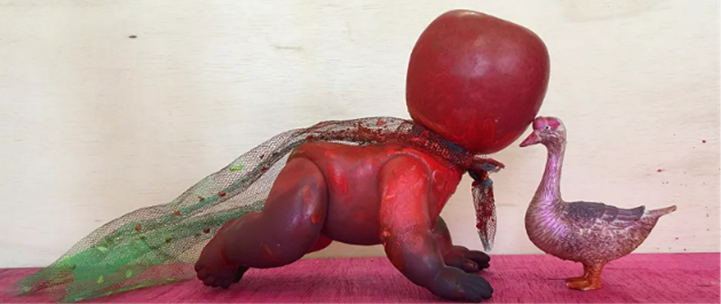
That willingness to combine forms also appears in Babel Baby, an installation consisting of 60 articulated dolls, plastic parts and other objects. Its strange, hybrid children are part human and part plant. In Cosmic Fable, she turns to painting to reflect on our transient existence. For her, painting participates in a wider cycle of energy, memory and transformation.
A story can begin anywhere
For someone like me who works with storytelling, Sacré cœur de Marie raises a familiar question: where does a narrative begin, and when does it end?
Many storytelling frameworks follow a straight line. Yet lived experience continues beyond the point where we stop telling a story. Looking back two years later, we may understand the same events differently.
Maria do Carmo’s installation makes that openness visible. Each heart holds a miniature narrative, but its relationship with the surrounding hearts creates further possibilities. A different arrangement changes the connections. A different path through the installation changes what the viewer encounters.
“Whatever you put together has no end, no definite beginning and, above all, isn’t linear,” she says. When I suggest that this sounds like life, she agrees.
Viewers respond to this openness in different ways. Some linger, determined to establish exactly what a work means. Others are more comfortable exploring without reaching a firm conclusion.
Maria do Carmo was particularly intrigued by the responses of children to the installation and how freely they engaged with it. They seemed less concerned with finding one unifying explanation and more willing to play with possibilities. That willingness comes close to the encounter she hopes for: attentive, curious and unburdened by the need to settle everything immediately.
A dimension of its own
Our conversation eventually turns to the difficulty of putting visual experience into words.
A written reference to a red dress leaves the reader to imagine its shade. A painting presents a particular red, whose effect begins as soon as we see it. Color, material, scale and spatial relationships contribute to an experience that a verbal explanation can only partly convey.
“If I wanted to talk or write about it, I wouldn’t paint,” says Maria do Carmo. “They are different ways of understanding.”
Speaking about art already involves distilling it. Writing requires a further act of selection: finding words for something that was created in another form. Painting allows Maria do Carmo to work through metaphor without the need for a verbal account of what an image represents.
Perhaps the best way to encounter her work is to begin with something that catches your eye. Follow it towards something else. Notice what changes. Among Maria do Carmo’s miniature worlds, the next story is about where you look next.